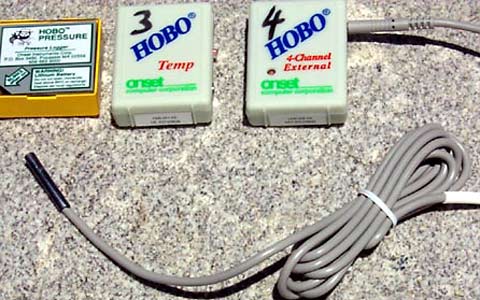
These matchbox sized devices are miracles of technology. We can program them to log data every few hours, and they will run for over a year. NASA has provided them to the expedition so that we can understand how barometric pressure, air temperature, and rock temperature change over the course of a year. We expect that the air pressure rises into summer (school project: why?) and then falls into winter. One question, inspired by research in the dry valleys of Antarctica and project members' observations at the South Col, is whether the rocks near the summit squeak above freezing during late spring and summer -- and where there's water there's probably life. The long lead trailing out of the right hand sensor is a temperature sensor which allows you to shelter the data-logger in a crevice and run the lead out to the rock surface, where it can be epoxied in place and monitor rock surface temperatures (which will be warmer than ambient air temperatures). —Charles Corfield (Tue, April 27, 1999)
|